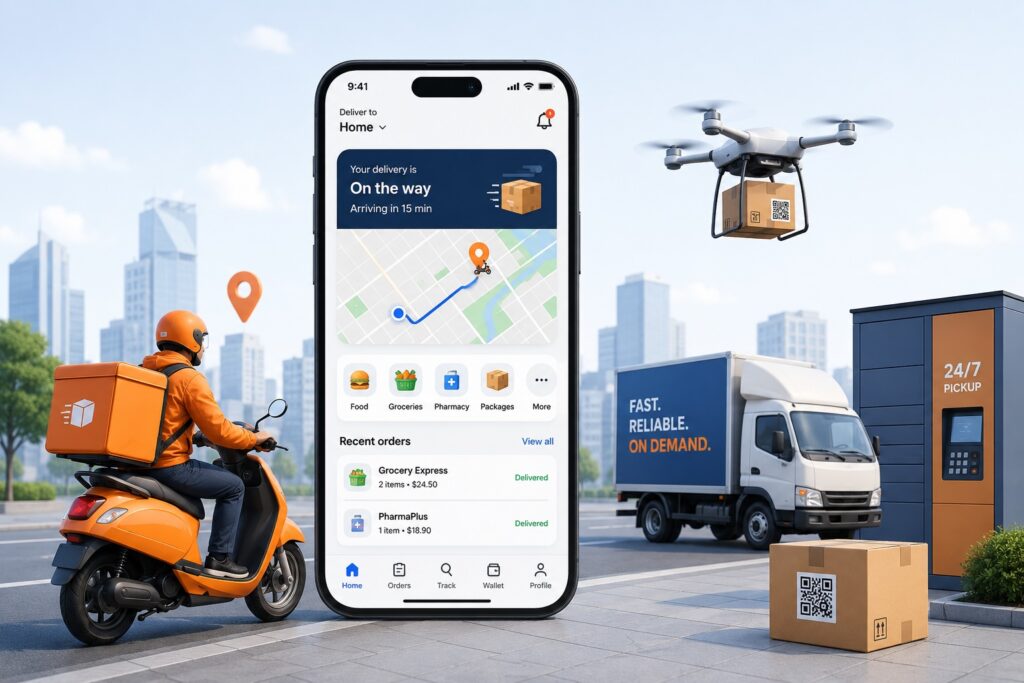
The landscape of on-demand delivery app development has shifted from a race for basic speed to a battle for architectural efficiency and unit economics. In 2026, enterprise platforms no longer compete simply by delivering goods quickly. Instead, companies win by building highly resilient, scalable digital systems that optimize every route, transaction, and user interaction. Market data indicates that the global delivery market is projected to grow to $1,415.19 billion by 2034, driven by a permanent transition toward mobile-first instant fulfillment.
While food delivery platforms laid the initial groundwork, the underlying technology has evolved into a universal operating model. Today, retail brands, pharmaceutical companies, enterprise B2B suppliers, and hyper-local logistics operations all rely on the same fundamental infrastructure.
This guide covers every major decision: what goes into a delivery platform, which features to prioritize, how to choose a tech stack that scales, what architecture choices actually matter, and what it realistically costs to build.
What is an on-demand delivery app?
An on-demand delivery app is a digital platform that connects customers with businesses and delivery providers, enabling users to order products or services and receive them within a specified timeframe.
Unlike traditional eCommerce systems that focus primarily on catalog management and checkout, delivery apps are designed around real-time operations. They coordinate ordering, dispatching, route optimization, tracking, payments, and customer support across multiple participants.
What an on-demand delivery app includes
A modern delivery ecosystem typically consists of four interconnected product layers:
- Customer app — where users browse, order, pay, and track their deliveries.
- Courier app — where drivers or couriers receive jobs, navigate, and confirm completion.
- Merchant/restaurant/partner app — where businesses manage incoming orders, update availability, and monitor performance.
- Admin panel — where the platform team manages operations, resolves disputes, and controls pricing.
How these layers work together
The platform’s value depends on how well these layers communicate. A simplified order lifecycle looks like this:
- Order placement. The customer selects items, confirms details, and pays. The order reaches the merchant instantly.
- Dispatch and matching. The system identifies the best available courier based on location, workload, availability, estimated delivery time, and other factors.
- Tracking and notifications. Both the customer and the merchant receive live updates as the courier moves. The ETA (estimated time of arrival) updates dynamically.
- Payment and payout. The platform processes the customer transaction and queues a payout to the courier, plus a commission split where applicable.
- Issue resolution. Late deliveries, missing items, and refund requests route through the admin layer for handling.
Types of on-demand delivery apps
While food delivery remains one of the most recognizable categories, today’s delivery market spans a much wider range of industries.
- Food delivery is the largest and most competitive vertical. It breaks down further into restaurant aggregator apps (platforms connecting customers with multiple restaurants), dark or ghost kitchens (delivery-only operations with no dining room), and B2B food delivery (connecting restaurants with ingredient suppliers).
- Grocery delivery adds inventory complexity. Platforms need real-time stock synchronization, substitution logic for out-of-stock items, and, in many cases, integration with dark stores or micro-fulfillment centers.
- Retail delivery involves variable package sizes, same-day fulfillment windows, and sometimes multiple pickup points within a single courier run.
- Pharmacy delivery operates under strict regulatory requirements. Age verification, prescription validation, and cold-chain handling add compliance layers absent from food delivery.
- Courier and parcel delivery platforms facilitate local and regional package transportation for individuals and businesses.
- Laundry services use delivery apps to schedule pickups, track orders, and manage returns.
- Multi-service delivery platforms span two or more verticals, allowing users to access food, groceries, retail products, and courier services through one application.
Must-have features by role
Modern on-demand delivery platforms serve multiple user groups simultaneously. Each group requires a dedicated set of features that support their specific workflow while keeping the entire delivery ecosystem connected in real time.
Customer app features
The customer application is the primary revenue-generating interface of your platform. Its job is to make ordering as fast, transparent, and frictionless as possible.
- Account creation and profile management enable quick registration with saved addresses and stored payment methods to streamline repeat orders.
- Search, browse, and cart/order flow provide a clean discovery experience with smart filtering by category, cuisine, distance, or rating.
- Real-time tracking offers a live map view of the courier’s location with a dynamic ETA, significantly reducing inbound support volume.
- Secure payments support multiple methods (cards, digital wallets, cash) with tokenized storage for fast, secure repeat transactions.
- Push notifications deliver real-time order updates (confirmation, assignment, proximity, delivery) to keep users continuously informed.
- Ratings and reviews allow users to rate both merchants and couriers, serving as the core mechanism to maintain quality control.
- Order history and reordering feature a one-tap repeat order button to effectively drive user retention at zero additional acquisition cost.
- Customer support provides in-app chat or ticketing tied directly to order IDs, ensuring users never have to leave the app to resolve problems.
- Scheduling allows advance booking for deliveries, which is crucial for scaling grocery and pharmacy verticals.
Courier app features
The courier application is responsible for operational efficiency. Well-designed courier workflows directly impact delivery speed, customer satisfaction, and profitability.
- Registration, verification, and onboarding handle KYC (know your customer) checks, license uploads, and background verifications to establish foundational platform trust.
- Job acceptance and rejection display upfront job details (e.g., pickup location, drop-off point, and estimated earnings) before a courier accepts a delivery.
- Route guidance integrates live navigation with multi-stop batching and sequencing to optimize the courier’s routes and hourly earnings.
- Earnings and payout tracking provide real-time income tracking, payout history, and tax summaries to boost courier retention and transparency.
- Proof of delivery secures timestamped photo captures or digital signatures against the order record to streamline dispute resolution.
- In-app chat and calls facilitate secure communication between couriers and customers without exposing personal phone numbers.
- Performance ratings and feedback show couriers their ratings and explain how their performance affects job priority or earnings tiers.
- Document and credential management tracks expiration dates for driver’s licenses, insurance policies, and vehicle registrations automatically.
Merchant or partner app features
Whether the platform supports restaurants, grocery stores, pharmacies, or retailers, merchants need tools to manage incoming demand efficiently.
- Incoming order management covers instant notifications, accept/reject controls, and granular tracking for order preparation status.
- Availability control empowers merchants to adjust operating hours, pause incoming orders, or mark specific items out of stock instantly.
- Menu or catalog updates allow merchants to adjust operating hours, pause incoming orders, or mark specific items out of stock instantly.
- Inventory tracking provides real-time visibility into stock levels across the grocery and retail verticals, helping prevent customer friction from substitutions or cancellations.
- Promotions and order analytics offer custom discount creation tools alongside deep insights into item performance, peak hours, and average order value.
Admin dashboard features
The admin dashboard serves as the operational command center of the entire platform.
- User and partner management centralizes account reviews, tier assignments, suspension workflows, and new merchant onboarding.
- Dispatch oversight displays a live operational map showing active orders, unassigned jobs, and real-time courier positions.
- Pricing and commission controls manage zone-based delivery fees, dynamic surge pricing, tiered commission rates, and promotional pricing structures.
- Dispute resolution and refunds automate workflows for investigating complaints, processing refunds, and flagging suspicious activity.
- Analytics and reporting generate comprehensive metrics on order volumes, delivery speeds, regional revenue, and cohort retention.
- Fraud prevention and compliance tools deploy automated detection rules to catch fake accounts, abnormal ordering behavior, and payment fraud.
Advanced features that improve retention and efficiency
Once an MVP proves market demand, advanced capabilities can significantly improve operational performance and customer retention.
- AI-powered dispatch, route optimization, and ETA prediction. Instead of simply assigning the nearest available courier, an AI dispatch system simultaneously weighs proximity, current load, traffic conditions, and predicted preparation time. The result is shorter actual delivery times, not just shorter theoretical ones. For couriers making multiple stops, route optimization compounds these gains by sequencing pickups and drop-offs to maximize efficiency.
- Demand forecasting. Predictive models analyze historical order patterns, weather, local events, and time of day to position couriers in high-demand zones before orders arrive. This reduces the gap between order placement and courier assignment — the single biggest contributor to perceived delivery speed.
- Dynamic pricing. Surge pricing during peak demand keeps courier supply available when it’s most needed. It’s a point of friction with customers, but it’s also standard practice on platforms that need to balance a live marketplace in real time.
- Loyalty and subscriptions. Monthly membership plans (e.g., free delivery, discounts, priority service) drive order frequency and create predictable revenue. They work best once the customer base is large enough that the value proposition is tangible.
- Multi-language and multi-currency support. Businesses expanding across regions need localization features that provide a consistent experience for international customers and partners.
- In-app wallet and marketplace payouts. Stored credit balances and instant courier payouts reduce friction on both sides and simplify payout reconciliation.
- Smart, behavior-based notifications. This isn’t about broadcast promotions; these should be targeted nudges based on order history, time of day, and local availability.
Choosing the best tech stack for on-demand delivery app development
Selecting your technology stack dictates whether your platform handles thousands of concurrent orders seamlessly or crashes during dinner-hour rushes.
Mobile frontend layer
Here is a structural breakdown of the leading mobile frameworks:
| Technology | Market suitability | Engineering highlights |
|---|---|---|
| Flutter | Most businesses building a cross-platform system from scratch. | Uses a highly optimized rendering engine to draw its own pixel-perfect UI elements at 60–120 fps (frames per second). |
| React Native | Product teams with deep JavaScript or TypeScript expertise. | Renders native components directly without serialization bridges. |
| Kotlin Multiplatform (KMP) | Android-heavy teams expanding core data and logic modules to iOS. | Allows Android and iOS apps to share business logic, networking, and data models, while each platform uses its own native UI. |
| Native (Swift/Kotlin) | Platforms requiring maximum hardware optimization or complex backgrounds. | Offers uncompromised access to device hardware Application Programming Interfaces (APIs), though it requires completely separate iOS and Android codebases. |
Backend technologies
There is no single “best” backend architecture or language for on-demand delivery app development. The right choice depends on your product stage, team expertise, and long-term scalability goals.
For an MVP, many companies start with a modular monolith, where the entire backend runs as a single application. This approach simplifies development, deployment, and maintenance while keeping costs under control.
As the app and its user base grows, many organizations gradually split their backend into microservices. Instead of a single large application, individual services handle specific responsibilities (e.g., order management, payments, dispatch, notifications, and route optimization). Each service can then use the programming language and framework best suited to its workload.
Some of the most common backend technologies include:
- Node.js (Express or NestJS). One of the most popular choices for delivery platforms because its event-driven architecture efficiently handles large numbers of concurrent connections. It is particularly well-suited for real-time features such as WebSocket communication, live tracking, notifications, and order status updates.
- Python (FastAPI or Django). Frequently used for data-heavy workloads, including route optimization, demand forecasting, recommendation systems, analytics pipelines, and machine learning services. Many mature delivery platforms combine Python services with other backend technologies rather than using it for every component.
- Java and Kotlin (Spring Boot, Ktor). Widely adopted by enterprise organizations that prioritize reliability, scalability, and long-term maintainability. These technologies are common in large transaction-processing systems, payment services, and high-volume business applications.
- Go (Golang). Increasingly popular for high-performance microservices thanks to its low memory footprint, fast execution, and excellent concurrency model. It’s often used for APIs, dispatch services, and infrastructure components that process large volumes of requests.
- Other technologies. Frameworks built with PHP (Laravel), .NET (ASP.NET Core), Ruby on Rails, Elixir, and Scala also power successful delivery platforms. Technology selection should always reflect business requirements and available engineering expertise rather than industry trends alone.
Database technologies
On-demand delivery platforms generate several different types of data simultaneously. Rather than relying on a single database, many production systems combine multiple storage technologies, each optimized for a specific workload.
- Relational databases (PostgreSQL, MySQL, SQL Server). These databases store structured transactional data, including customers, merchants, orders, payments, invoices, and financial records. PostgreSQL is a particularly common choice because of its reliability, rich feature set, and strong support for complex queries, but it is far from the only option.
- Document databases (MongoDB). Ideal for flexible, evolving data structures such as merchant catalogs, product attributes, delivery preferences, or configuration settings that vary across businesses.
- Redis. An in-memory database used for high-speed caching, session storage, rate limiting, job queues, and frequently changing information like driver locations and live order status.
Large-scale platforms may also add specialized databases for full-text search, analytics, time-series data, or recommendation engines as their infrastructure evolves.
Cloud infrastructure
Your infrastructure needs to expand dynamically when orders surge and scale down during quiet midnight hours to minimize overhead.
- Amazon Web Services (AWS). It offers one of the industry’s most comprehensive cloud ecosystems, including Elastic Compute Cloud (EC2), Relational Database Service (RDS), ElastiCache, Lambda, and numerous managed services. It is widely used by startups and enterprise-scale delivery platforms alike.
- Google Cloud Platform (GCP). This option provides native integration with Firebase modules and top-tier infrastructure for machine learning. It can be an ideal environment if your product heavily leverages spatial modeling.
- Microsoft Azure. The default environment for large-scale enterprises with pre-existing Microsoft agreements or strict compliance requirements in corporate logistics.
Maps, geolocation, and payments
Location services power address validation, navigation, ETA calculations, route optimization, and live driver tracking.
- Google Maps Platform. The most widely adopted mapping ecosystem, offering geocoding, routing, traffic data, and Places APIs.
- Mapbox. A popular alternative that provides extensive map customization and can become more cost-effective for businesses with high API usage or specialized visualization requirements.
Payment infrastructure should support secure checkout, refunds, recurring billing, and marketplace payouts.
- Stripe, PayPal, Apple Pay, and Google Pay are widely used payment solutions in North America, Europe, and many international markets. Stripe Connect is particularly popular for marketplace platforms because it simplifies multi-party payouts between customers, merchants, couriers, and the platform.
Payment preferences vary significantly by region. Many businesses integrate local providers alongside global gateways (e.g., Razorpay in India and Mercado Pago in Latin America) or other country-specific payment processors to support local payment methods and improve conversion rates.
Analytics tiers
A robust analytics infrastructure is critical for monitoring platform health and understanding how users interact with your application.
- Behavior tracking (e.g., Mixpanel, Amplitude, and Firebase Analytics). These services reveal where users drop off, trace conversion paths, and monitor user behavior across your customer personas.
How to choose the right stack
Every software architecture decision involves trading speed for scale. Your specific operational bottlenecks should dictate your framework choices.
1. By launch speed. If you need to enter the market within three to four months, choose a unified language stack. Combining Flutter or React Native on the frontend with Node.js and an established platform-as-a-service (PaaS) like Supabase or Firebase dramatically accelerates deployment. This minimizes configuration friction, letting developers ship a working MVP faster.
2. By budget constraints. Cross-platform frameworks reduce mobile development costs by 30% to 40% compared to dual-native builds. To keep your backend costs lean, use open-source backend libraries and standard relational databases such as PostgreSQL. This avoids heavy third-party vendor lock-in or surprise subscription increases down the road.
3. By team skills. Teams already experienced with React and TypeScript often have a shorter learning curve when adopting React Native because many development patterns are familiar. However, building production-quality mobile applications still requires expertise in mobile architecture, platform conventions, performance optimization, and native integrations. If you lack internal mobile developers, collaborating with a reliable software development partner helps bridge these capability gaps without recruitment delays.
4. By scalability needs. If your long-term roadmap involves expanding to 50 cities within two years, choose an architecture ready for microservices from day one. Build your architecture so services can evolve independently as demand grows. Container technologies such as Docker, orchestration platforms like Kubernetes, managed cloud services, and well-defined APIs make it easier to scale individual components without rebuilding the entire platform. The underlying implementation may use Node.js, Go, Java, Python, or a combination of technologies, depending on the workload.
5. By whether AI is core or secondary. When AI serves as a secondary feature (like automated customer support chatbots), a pure Node.js backend handles external API calls perfectly. However, when AI becomes a core differentiator (e.g., powering dispatch optimization, pricing, or demand forecasting), it often makes sense to separate those workloads into dedicated machine learning services. Many production platforms expose these services through APIs while keeping customer-facing APIs, payments, and real-time communication in their existing backend stack. This allows each component to evolve independently and use the technologies best suited to its purpose.
Architecture and scalability
Building an on-demand logistics platform may seem straightforward when you’re managing 50 active orders. The real challenge begins when thousands of customers place orders simultaneously during peak demand. Without a scalable architecture, response times increase, dispatch becomes slower, databases turn into bottlenecks, and critical services may become unavailable. Planning for these scenarios from the outset helps ensure your platform remains fast and reliable as it grows.
What breaks first at scale
Scaling an on-demand delivery app exposes structural weaknesses across your entire ecosystem. These specific bottlenecks consistently trigger performance degradation when traffic volumes surge:
- Dispatch latency: standard matching engines rely on basic database queries to calculate the distance between available couriers and merchants. As concurrent volume doubles, these geospatial lookups lock database tables. Your matching engine slows down, delivery ETAs skyrocket, and users abandon the checkout flow.
- Tracking accuracy: thousands of mobile courier devices streaming location updates simultaneously create massive data traffic. If your engineers route these high-frequency pings through standard HTTP (Hypertext Transfer Protocol) endpoints, your servers quickly run out of available threads. The result is frozen map markers and broken customer interfaces.
- Payment reconciliation: processing multi-party split payouts dynamically introduces state issues at scale. High transaction volumes frequently cause synchronization errors between third-party processors, driver ledgers, and merchant accounting systems. This leaves your finance teams chasing mismatched payment data manually.
- Support and refund workflows: when a service disruption triggers mass cancellations, monolithic systems struggle to process thousands of refund transactions simultaneously. This bulk data processing clogs the main database write queues, preventing new orders from clearing.
- Database bottlenecks: on-demand apps generate heavy read/write concurrency. Your database must continuously update courier coordinates, order statuses, and merchant inventory layers simultaneously. Without strategic data separation, this massive write load causes severe I/O resource starvation, crashing the entire platform.
Architecture choices that help
Engineering teams solve these high-concurrency challenges by moving away from rigid systems. Instead, they deploy highly decoupled, elastic infrastructure patterns designed to handle unpredictable transaction loads:
- Modular architecture: avoid jumping straight into complex microservices for an early MVP. Instead, your developers should build a modular monolith with strictly isolated domain boundaries. This structure enforces clean code separation from day one. It also allows your team to easily decouple individual high-load workflows into autonomous microservices later without rewriting the system.
- API-first design: treat every internal service, whether it is the dispatch engine, billing ledger, or notification manager, as a completely independent product. Building your ecosystem around well-documented, secure APIs ensures that your frontends and external merchant systems communicate seamlessly. This design strategy isolates systemic failures and simplifies long-term maintenance.
- Event-driven workflows: forgo traditional synchronous request-response chains in favor of an asynchronous communication architecture. Your engineering teams should utilize message brokers like Apache Kafka or RabbitMQ to orchestrate backend operations. When a customer submits an order, the platform publishes an immediate event message. Separate downstream microservices, then process the payment, update the merchant panel, and trigger the matching engine independently. This prevents a slow third-party API from delaying your entire ordering pipeline.
- Caching for live location and order status: high-frequency, ephemeral data updates do not belong in your primary transactional storage tables. Your developers must isolate real-time GPS tracking coordinates and active order state changes within an in-memory database tier such as Redis. This approach serves rapid location updates to customer client apps via persistent WebSockets while keeping your primary PostgreSQL tables clear of unnecessary resource strain.
- Observability and monitoring: you cannot optimize what you do not measure. Your team must implement an end-to-end observability pipeline using frameworks like OpenTelemetry (OTel), Prometheus, and Grafana. This monitoring stack tracks distributed request paths across your four-sided ecosystem. It allows operations teams to isolate memory leaks, pinpoint query latency increases, and resolve system performance anomalies before they impact the end-user experience.
Scale with dedicated teams of top 1% software experts across 15+ global hubs to double development velocity while maintaining cost efficiency.
Talk to an expertBusiness model options
In the hyper-competitive on-demand space, relying on a single revenue stream rarely yields long-term profitability. Companies must design a multi-layered monetization framework that balances customer acquisition costs against sustainable margins. The most successful platforms combine multiple commercial strategies. They convert transaction volume into predictable revenue loops while keeping all market participants engaged.
Core monetization models
To build a resilient platform, your commercial infrastructure should integrate several of these primary revenue mechanisms:
- Commission models are the cornerstone of the marketplace economy. Your platform charges partner merchants a fixed percentage (typically between 15% and 30%) for every transaction completed through your interface. Your backend must automatically calculate this take-rate in real time before distributing the remainder to the vendor.
- Delivery fees are charged directly to the end-user to offset logistics and courier fulfillment costs. These fees can operate as a flat rate for hyper-local zones or adjust dynamically based on distance matrices. Many platforms pass the majority of this fee directly to the courier to keep the fleet motivated.
- Subscription plans are the ultimate driver of predictable monthly recurring revenue (MRR). By offering a premium delivery pass tier, users pay a flat monthly subscription fee to unlock waived delivery fees and exclusive merchant discounts. This model changes consumer behavior, turning occasional users into highly loyal brand advocates.
- Promoted listings can be a high-margin native advertising engine for partner merchants. Restaurants or retail stores pay a premium fee to secure priority placement at the top of localized user search feeds. Your team must design a bidding pipeline that balances ad visibility without degrading user search relevance.
- Surge pricing engines are algorithmic multipliers that automatically increase delivery and service fees when order volume exceeds available courier capacity. This dampens excess demand, incentivizes more couriers to go online, and maximizes platform margins when capacity is tight.
- Partner and service fees: apply fixed platform or technology fees to each order. This revenue helps fund ongoing cloud infrastructure maintenance, payment processing tokenization overhead, and customer support workflows without eating into your core transaction margins.
Quick tip: when structuring your monetization matrix, consider your target vertical and market density. For instance, an aggregator platform thrives on high transaction volumes, making a combination of commissions, delivery fees, and promoted listings highly profitable. Conversely, a hyper-local niche delivery service might rely on premium service fees and subscriptions to offset a lower order volume.
The ultimate goal is to align software architecture with your commercial objectives. By building a flexible billing engine that lets you adjust commissions, activate surge protocols, and dynamically deploy promotional features, you ensure your platform stays agile, competitive, and profitable.
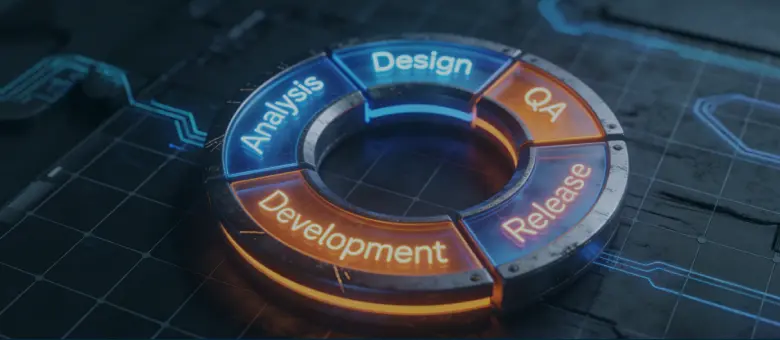
How to build an on-demand delivery app
A well-sequenced build avoids the two most common failure modes: over-engineering before the model is validated, and under-building to the point where the platform can’t function reliably for real users.
Step 1: validate the market and business model. Research actual demand in your target market and vertical. Identify underserved niches (e.g., the aggregator model is dominated by incumbents in most major cities, but courier and grocery delivery still have room for focused players).
Step 2: define user roles and MVP scope. Map out which user roles your first release needs, which features are essential for each, and which can wait. An MVP that delivers a reliable core experience across all active sides is more valuable than an unstable, feature-rich build.
Step 3: design user flows and prototypes. Build interactive prototypes for the customer and courier apps before development begins. Test them with real potential users. Changing a flow in a prototype costs almost nothing; changing it after development does.
Step 4: build and integrate core features. Development proceeds layer by layer (frontend, backend, APIs, admin panel) with continuous integration of third-party services.
Step 5: test with real users. Beta testing across multiple devices, operating systems, and network conditions surfaces issues that internal testing doesn’t. Edge cases in GPS tracking and payment flows are especially common. A staged rollout to a limited audience reduces the blast radius of problems that testing didn’t catch.
Step 6: launch and iterate. Start in one city or region. High density of couriers and customers in a small area is what makes the marketplace feel active and useful. Sprawling geographically too early dilutes the experience on both sides. Measure everything from day one: order completion rate, courier acceptance rate, average delivery time, and customer reorder rate. Let data drive the roadmap.
How much does it cost to build an on-demand delivery app?
Development cost varies significantly based on scope, team location, and technical complexity. The following ranges reflect custom development with an experienced team.
The major cost drivers:
- Features. Real-time tracking, AI dispatch, and demand forecasting each add meaningful cost.
- Platforms. A cross-platform mobile build covers both iOS and Android from one codebase, reducing mobile-layer cost significantly versus native. Four-sided platforms (customer + courier + merchant + admin) cost more than two-sided ones.
- Integrations. Third-party Point of Sale (POS) systems, payment gateways, and mapping services each require development time to integrate and test properly.
- Development team. Senior engineers with delivery platform experience cost more per hour but produce fewer rework cycles. Choosing the right software development partner pays for itself in avoided surprises.
- Geography. Teams in Eastern Europe typically bill at $40–$80/hour, compared with $100–$250/hour for US-based agencies, with comparable output quality when properly vetted.
Beyond the build, several ongoing costs can catch teams off guard:
- Cloud hosting scales with active users and GPS data volume — budget meaningfully more than your dev environment costs.
- Maps and routing APIs charge per use. Active delivery platforms spend real money on Google Maps at scale.
- SMS and OTP (one-time password) verification via services like Twilio adds up with user volume.
- AI inference costs if using third-party ML services.
- Compliance for regulated verticals (pharmacy, alcohol) requires legal and technical investment before launch, not after.
- Maintenance typically runs 15–20% of the original development cost per year.
- Customer and courier acquisition (often the highest cost in year one) is outside the development budget but needs to be planned alongside it.
White label vs. custom development
For teams with tight budgets or short timelines, white-label delivery platforms offer a faster path to market. Pre-built solutions can be customized with your brand and launched in weeks. For simple, localized use cases where differentiation isn’t a priority, they’re worth evaluating.
However, white-label platforms offer limited control over the customer and courier experience, which is precisely where delivery apps win or lose. They’re also difficult to differentiate: if competitors can buy the same platform, the product itself isn’t a competitive advantage. And when growth outpaces what the pre-built solution can handle, migration to custom development is effectively a rebuild anyway.
Custom development costs more upfront, but it gives full codebase ownership, flexibility to match your exact business model, and the ability to scale without platform constraints.
Many teams start with a white label to validate demand before committing to a custom build. That’s a legitimate strategy, but it works best when the team enters with clear eyes about the likely rebuild cost if the model takes off.
Best practices when building an on-demand delivery app
Prioritize based on market data. The delivery space is crowded. Standing out requires a genuine understanding of what the supply side and demand side actually need in your specific market. Talk to couriers before building the courier app. Survey potential customers before specifying the order experience.
Don’t sacrifice the experience on either side. On-demand delivery lives or dies on real-time transparency. Customers who can see exactly where their order is and what to do if something goes wrong will tolerate a late delivery. Customers left wondering won’t return. The same principle applies to couriers: an app that’s slow, confusing, or unreliable drives churn on the supply side before customers even notice.
Build for scale from the architecture up. Modular design lets teams extend features without constant rewrites. An API-first approach ensures clean integration with the third-party services every delivery app depends on. These decisions determine whether your platform can handle 100x its launch-day volume without a rebuild.
Real-world examples of successful delivery apps
The gap between a delivery app that works in a demo and one that holds up at scale is where most projects run into trouble. These three case studies illustrate what that transition actually requires.
Case #1: scaling to 4 million daily orders
AgileEngine partnered with a Fortune 500 Europe-listed multinational food delivery platform to scale its technical infrastructure across a global operation.
Our engineers handled full-stack development, UI/UX design, and API development — building a scheduling tool, a RESTful API backend, and a single-page application (SPA) for mobile. The resulting system supports up to 4 million daily orders and over 500,000 restaurant partners across 70+ countries.
The team also built internal mobile and web applications to manage promotional campaigns run by external agencies across all those markets — a coordination problem that rarely appears in a feature spec but demands significant engineering effort in practice.
Case #2: high-load routing and logistics optimization
In a different engagement involving France’s most-funded startup, AgileEngine’s full-stack engineers built a high-load delivery system optimized for rapid urban food delivery. Key deliverables included order processing and distribution across city districts, route calculation for couriers, a personalized recommendation algorithm, and an order packaging optimization system.
Beyond the core build, the team developed a B2B admin panel for restaurant partners, enabling the client to shift from a purely B2C (business-to-consumer) operation and expand beyond their home market. The packaging optimization work reduced material waste and delivery complexity in ways beyond the original brief, with measurable operational impact.
Case #3: from monolith to microservices
AgileEngine modernized the backend for a restaurant delivery platform operating in Canada and Japan. The existing monolithic architecture had become a bottleneck for both feature development and reliability. Our team re-architected it using microservices, built new UI dashboards for client-facing and administrative use, and improved overall stability.
Following these improvements, the platform achieved a 4.7-star rating on the App Store and recognition as a top “Emerging Rocket” startup. The migration illustrates a pattern that recurs in delivery platform development: starting with a modular architecture is always cheaper than migrating to one later.
Final thoughts
On-demand delivery app development is one of the more technically demanding areas of mobile software development. The platforms that succeed are the ones that get the fundamentals right: a reliable real-time experience for both customers and couriers, architecture that scales without constant intervention, and a business model with sustainable unit economics.
A few principles hold across every delivery platform we’ve worked on:
- Start with the business model before scoping features
- Build an MVP that’s genuinely reliable before expanding the scope
- Choose a tech stack that matches your team’s skills and your scalability timeline
- Treat logistics optimization as a first-class engineering problem
- Scale market by market rather than spreading thin geographically
If you’re planning to build an on-demand delivery app or re-architect an existing platform, we’re here to help you every step of the way.
Boost development efficiency without breaking the budget. Our dedicated teams offer 2X cost savings, delivering in-house-level quality
Let’s chatFAQ
Cross-platform development with Flutter or React Native is the right default for most delivery apps. It covers both iOS and Android from a shared codebase, saving 30–40% in mobile development costs. Native development (Swift for iOS, Kotlin for Android) makes sense only when the platform has genuinely mission-critical performance needs, such as a high-frequency logistics network with hundreds of concurrent active deliveries, where maximum rendering performance and deep platform integration justify the additional investment.
Yes, but only if the architecture supports it from the start. Platforms built for a single vertical sometimes make data model assumptions that don’t translate cleanly to another vertical. If multi-vertical expansion is on the roadmap, tell your engineering team before development begins, not after the first version launches. An API-first, modular architecture makes the expansion significantly smoother and avoids a costly redesign.
Separate apps are the standard approach. The customer experience and the courier experience are functionally opposite: one optimizes for browse-and-order simplicity, the other for real-time task execution and navigation. A combined app typically compromises both. Some early-stage platforms ship a single app to reduce initial build cost, but most outgrow it quickly once supply-side retention becomes a priority.
Cloud infrastructure auto-scaling is the foundation — AWS, GCP, or Azure automatically provisions additional compute capacity when demand spikes and scales back down when demand drops. Beyond infrastructure, caching layers absorb read volume without hitting the primary database. Dispatch systems specifically need load testing under simulated peak conditions before launch; this is where latency problems most commonly surface first in production.
Yes, and for most startups and mid-sized businesses without a large engineering team, it’s the most practical path. Outsourcing gives you access to teams that have already solved the specific problems delivery platforms face. The key is to choose a dedicated development team with verifiable experience on delivery platforms. Check case studies, ask for references from delivery-specific clients, and confirm the team has handled the complexity your platform requires.









![A smartphone and a tablet with monetization elements (banner ad and in-app purchase button) displayed on the screen]](https://dliwjjrllagqi.cloudfront.net/wp-content/uploads/2026/03/How-Do-Free-Apps-Make-Money_-Monetization-Explained.webp)